Demand planning · Procurement · Operations automation

I decide what a parts business buys, how much, and from where.

Procurement planning across 17 brands, 9,000+ SKUs and nine source countries in the automotive aftermarket. I run the cycle from enquiry to goods receipt, negotiate what we pay for it, clear it through customs, and write down the method so it runs without me.

Open to demand planning, supply chain and inventory roles internationally. Available within a month, open to relocation.

17
Brands planned
Each with its own lead time, MOQ and ordering rules.
9,000+
SKUs managed
Every one has a cover figure and an order decision behind it, including the decision to buy nothing.
9
Source countries
Asia, Europe and the US, each on a different clock.
10 to 25
POs raised monthly
Across weekly, monthly and quarterly cycles by brand.
240+
HS codes maintained
The customs register every shipment clears against.

Flagship

Where the cash was actually sitting.

An eight-part inventory and capital intelligence audit, built from the company's own data and taken to leadership.

Capital intelligence8-part audit

A capital audit that surfaced six figures of recoverable working capital

It showed where cash was trapped, where stockouts were about to bite, and how much supply sat exposed to the Strait of Hormuz. Then it set a phased recovery plan against all three.

Six figures of working capital identified as recoverable, mapped from the company's own data and taken to leadership.
60x span
Brand turn ratios across a sixty-fold spread, exposing where capital sat idle.
2,000+ SKUs
Dead stock identified for clearance, concentrated in a few slow brands.
900+ movers
Fast movers under two months of cover with nothing in the pipeline.
Hormuz map
Quantified the supply exposed to the Strait of Hormuz for re-sourcing.

Case study · Supply disruption

Four months stuck in Jebel Ali.

Consignment heldMar 2026 to Jul 2026

Japan to Muscat, with four months of it sitting in a freezone.

Situation
An LCL consignment from Japan went into Jebel Ali in March 2026 and did not come out. Consolidated cargo, multiple owners on one container, and the Hormuz disruption reshuffling schedules and paperwork across the whole route. Every week it sat there, the parts on it were parts we could not sell.
Complication
LCL is harder than a full container when things go wrong. You do not control the box. You are one shipper among several, the release depends on the consolidator, and the documentation has to satisfy customs on both sides before anything moves. The default outcome is that it sits until someone makes it their problem.
What I did
Made it my problem. Appointed a clearing agent who could actually work the freezone side rather than the one who was convenient, rebuilt the documentation chain so the classification and values held up first time instead of bouncing back, and chased the release through to the point where the cargo moved.
Result
Cleared in July 2026 and delivered into stock.
LCL consolidated cargo Jebel Ali freezone Hormuz disruption Clearing agent appointed

Held for

Four months

Four months is not a win, and I would not present it as one. What it shows is that when a consignment stops moving, I do not wait for the forwarder to solve it.

Procurement

From enquiry to goods receipt.

The full cycle sits with me, not just the forecast.

The order cycle, six stages Enquiry, then quotation and negotiation, then purchase order, then shipment, then customs, then receipt and goods received note. Receipt data feeds back into the next forecast. Forecast in Stock out 01 Enquiry 02 Negotiation 03 Purchase order 04 Shipment 05 Customs 06 Receipt and GRN Against forecast vs market rates GM sign-off, ERP LCL or FCL booked EXW, FOB, CIF Reconciled line by line Receipt data feeds the next forecast
The order cycle as I run it. My own process, drawn from scratch, with no employer data.

01 · ENQUIRY

Raised against the forecast

Enquiries go to suppliers with quantities already set by demand rather than guesswork.

02 · QUOTATION

Negotiated on market rates

Review incoming quotations and negotiate price against prevailing market rates, alongside MOQs, lead times and payment terms.

03 · PURCHASE ORDER

Prepared for GM sign-off

Prepare the PO for sign-off, then upload and amend it in the ERP and move it into transit.

04 · SHIPMENT

Booked against a benchmark

Compare freight forwarders for LCL and FCL against a 30% gross-profit benchmark, consolidating brands into single shipments to cut cost.

05 · CUSTOMS

Cleared, and chased when held

Issue clearance documentation to agents at Oman port under EXW, FOB and CIF terms, and step in when a consignment is held.

06 · RECEIPT

Reconciled line by line

Raise the GRN, reconcile the PO against invoice and packing list, inspect damaged goods, and recover value through claims, credit notes and free-of-charge replacements.

Incoterms: EXW · FOB · CIF · CFR Payment: TT and Letter of Credit 31,000+ pieces reconciled across eight orders

Method

How the order quantity is decided.

Long-run average sets the quantity, lead time sets how much cover to hold, and recent trend picks the multiplier. Every order traces back to a rule, which is why it can be explained on the spot.

The forecasting decision logic Monthly Average Demand sets the base quantity. Supplier lead time sets the cover target. Short lead times sourced regionally are not pre-stocked, mid lead times hold about seven months, and long lead times about nine to ten. The recent trend against the long-run average selects the multiplier. Slowing reduces cover, stable holds the default, and a spike is flagged for review rather than auto-ordered. Stock held under every brand carrying the same physical part is pooled before the order is placed. The order quantity is the cover target minus everything already in the system, floored at zero. Inputs Rules Output Long-run demand Monthly Average Demand Supplier lead time Sets the cover target Recent trend Short run against long run Base quantity from the average The long run, not the last busy month Cover follows lead time Short lead, sourced regionally not pre-stocked Mid lead hold about seven months Long lead hold about nine to ten months Trend selects the multiplier Slowing cover reduced Stable default cover held Spike flagged for review, never auto-ordered Order quantity Cover target, minus everything already in the system: stock, open POs and transit Floored at zero Cross-brand pooling stock held under every brand carrying the same physical part is counted before anything new is bought.
The decision logic behind every order line. Structure only, drawn from scratch. Cover bands are shown as approximate ranges and no employer figures appear.

Measurement

What I actually track.

Forecast accuracyReviewed each cycle, feeding the next set of order quantities.
Supplier OTIFOn-time in-full performance by supplier, scored and escalated.
Stock turn and DOIBy brand, which is where idle capital shows up.
Fill rate and stockoutsLines running short of cover with nothing inbound.
ABC analysisItems ranked by value and movement so effort follows the money.
Brand-level marginWhich brands earn their shelf space.
Competitor price benchmarkingOur pricing against the local market.
Landed costFreight, duty and clearance carried back to the part.
Cover monitorDemonstration only
Forecast accuracy
87%
Supplier OTIF
74%
Stock turn
2.4x
Lines below cover
38

Months of cover by brand

Months of stock cover by brand, demonstration data Six brands. Brand A 11.2 months, Brand B 8.4, Brand C 6.9, Brand D 4.1, Brand E 2.3, Brand F 1.4. The target cover line sits at seven months. All figures are invented. Target cover, seven months Brand A 11.2 Brand B 8.4 Brand C 6.9 Brand D 4.1 Brand E 2.3 Brand F 1.4

Lines needing a decision

PartCoverInboundState
XX-4471-A0.8 monthsNoneCritical
XX-2210-C1.6 months60 daysWatch
XX-9034-B2.1 months30 daysWatch
XX-1188-A9.4 monthsNoneOverstocked
Demonstration only. Every brand name, part number and figure on this panel is invented to show the shape of the reporting. No employer data appears anywhere on this page.

AI and automation

Systems built, not bought.

Most planning teams still run on manual reports. I build the automation instead of waiting for it.

Flagship automationMonthly close

Three reports in, a validated month out

Receipts, sales at cost and closing stock go in. The process validates them against each other, halts on any discrepancy rather than writing bad numbers, then produces the month's inventory position. A multi-day manual close became a same-day one.

Days to hoursHard validation gateRepeatable by anyoneFull audit trail
Knowledge base7 domains

An operations knowledge base a system can run

A structured workspace covering audit, customs, freight, inventory, order planning and suppliers, each with its own written operating manual. The result is something a system can execute work against, not a folder of files. Decisions that lived in one person's head are now written rules.

7 operating domainsMachine-executable
Python · Flask · HTMLShipped

Tools built and shipped

An operations dashboard consolidating supplier enquiries, proforma invoices, shipment status and payments into one workflow. A pricing and stock app the sales team uses in the field. A five-year sales intelligence workbook covering GP trends, account health and product-group performance.

Used daily by salesPower BI reporting
Order planning engine17 brands

Forecasting that explains itself

Monthly Average Demand forecasting across the full brand range, with lead-time thresholds setting the cover target, trend selecting the multiplier, and the same physical part pooled across every brand that carries it before anything new is bought.

70% faster orderingOverstock prevention built in

How I work

If I left tomorrow, nothing stops.

Most planning roles sit in one person's head. Mine does not, and that was deliberate.

The order planning method is written down and colleagues are trained on it. The customs classification rulebook covers dead codes, exempt codes, freezone re-export and country-of-origin floors, so the checks run the same way whoever is doing them. The monthly close validates its own inputs and halts on a discrepancy rather than quietly writing bad numbers. The operations workspace holds a written manual for each domain.

The test of a planning function is not whether it works while you are watching it. It is whether it works when you are not.

Written rulebooks Trained successors Self-validating close

Selected work

Catches, controls and cost.

Figures are shown as ratios and outcomes to keep employer data confidential.

CASH-02

5-figure

Caught a supplier double-payment

A running invoice-to-payment ledger caught it before the money left, and the balance was held until both sides reconciled.

RISK-03

2.7x

Flagged over-ordering before it landed

Pending orders were running at 2.7 times stock cover. Caught and escalated before more was committed, heading off a working-capital squeeze.

PROC-06

3 to 4 brands

Protected availability without holding more stock

The same physical part is carried across three or four brands. When one runs short before the container lands, I push the alternative or source urgently from UAE stockists, so the sale holds without carrying extra cover on every line.

NEG-07

2%

Moved a supplier who was not moving

A Chinese supplier held firm on price across a full order cycle. I went back with market rates, our order history and what the same part was landing at elsewhere, and kept the conversation open rather than escalating it. They came down 2%. Small on paper, real money on a recurring order, and the relationship held for the next one.

CUST-04

234/235

Reconciled the customs register

Three years of registrations on Oman's Bayan system brought into match, plus a price-floor check that flags under-declared freezone values before customs does.

OPS-01Half-year review

Read a sales dip the business had misread

Situation
First-half sales dipped and leadership read it as lost demand.
What I did
Built a half-year review from five years of ERP data for the General Manager and CEO, separating the core parts business from the battery line.
Result
The core business held its margin. A battery line had fallen under a new anti-dumping duty. Traced to cause, and answered with a GCC-origin re-sourcing route.

Briefed

GM and CEO

Core margin held. The number reframed for leadership before a decision was made on the wrong reading.

Capabilities

What I bring.

Demand planning

  • Demand forecasting (MAD)
  • S&OP and forecast review cycles
  • Forecast accuracy tracking
  • Safety stock and reorder points
  • Stock cover and DOI analysis
  • ABC analysis
  • Fill rate and stockout tracking
  • Replenishment and dead-stock prevention

Procurement and trade

  • Enquiry and RFQ handling
  • Quotation review and price negotiation
  • Purchase order processing and GRN
  • PO to invoice reconciliation
  • Supplier sourcing, onboarding and contracts
  • MOQ, lead time and payment term negotiation
  • Supplier KPIs, scorecards and OTIF
  • Claims, credit notes and warranty recovery
  • Incoterms: EXW, FOB, CIF, CFR
  • Letters of Credit and TT payments
  • Freight forwarder selection, LCL and FCL
  • Customs and HS classification, Oman Bayan

Category and product data

  • Range selection and rationalisation
  • Pricing and margin setting
  • Product lifecycle and discontinuation
  • Part number creation
  • OEM and competitor cross-referencing
  • Item master and catalogue management

Data, AI and reporting

  • AI workflow automation
  • Python, Pandas and Flask
  • Advanced Excel
  • Power BI
  • ERP data extraction and reporting
  • Working capital and GP analysis
  • Weekly and monthly management reporting

Experience

Where the method runs.

Apr 2024 to present

Product & Marketing Executive

Diamond Auto Spare Parts, Muscat, Oman

  • Plan procurement across 17 international brands and 9,000+ SKUs from nine countries, running weekly, monthly and quarterly ordering cycles by brand and lead time, and raising 10 to 25 purchase orders a month.
  • Run the enquiry to purchase order cycle: raise enquiries, review quotations and negotiate price against prevailing market rates, then prepare the PO for GM sign-off, upload and amend it in the ERP, move it into transit and raise the GRN on arrival.
  • Track every PO from confirmation to warehouse receipt, then reconcile against invoices and packing lists line by line, recently across 31,000 plus pieces over eight orders, inspecting damaged goods and recovering value through claims, credit notes and free-of-charge replacements.
  • Run the forecast review cycle using Monthly Average Demand with lead-time thresholds and brand-specific rules, setting safety stock and reorder points per part, and protect availability between shipments by substituting across the brands carrying the same part or sourcing urgently from UAE stockists.
  • Source and onboard new suppliers, negotiate MOQs, lead times and payment terms, manage supplier agreements and escalations, and handle payment by TT and Letter of Credit under EXW, FOB and CIF terms.
  • Book and compare freight forwarders for LCL and FCL against a 30% gross-profit benchmark, consolidating multiple brands into single shipments, re-sourcing to alternative origins to avoid duty exposure or delay, and issuing clearance documentation to agents at Oman port.
  • Own the range for my brands: evaluate new brands and products to take on, decide what to stock and what to discontinue, set pricing and margin, and maintain the catalogue including part number creation, OEM and competitor cross-referencing and item master corrections.
  • Track and report forecast accuracy, supplier on-time delivery, stock turn and DOI, and fill rate against stockouts, alongside ABC analysis and competitor price benchmarking.
  • Report weekly and monthly to management on stock cover, gross margin and supplier performance, and present analysis directly to the General Manager and CEO.
  • Built and maintain the HS-code register on Oman's Bayan system, and wrote the classification rulebook the customs checks run on, including a price-floor check that flags under-declared freezone values before customs does.
  • Work with brand principals against annual targets, consistently met, run their campaigns locally, deliver product training seminars across Oman drawing 150 plus attendees, and recover supplier marketing funds through co-op claims including a five-figure reimbursement prepared and submitted end to end.
  • Identified over 2,000 dead SKUs for clearance, isolated the small group of items generating 80% of gross profit, and mentor colleagues on the order planning and customs classification methods.

Dec 2023 to Jan 2025

Head of Marketing and Strategy, freelance

Puma Performance Pathway, remote

  • Built Power BI dashboards that fed into leadership decisions.

Sep 2022 to Sep 2023

Marketing Officer, promoted to Systems Support Officer

Netcom Training, Birmingham, UK

  • Promoted within three months after taking ownership of the FLG CRM and getting results from it that others were not.

Education

MSc International Marketing ManagementCoventry University, UK · 2021 to 2022
B.Com (Professional)Manipal University, India · 2016 to 2020ACCA Diploma with 9 papers exempt. Focus on taxation, accounting and financial analysis.

Certifications and languages

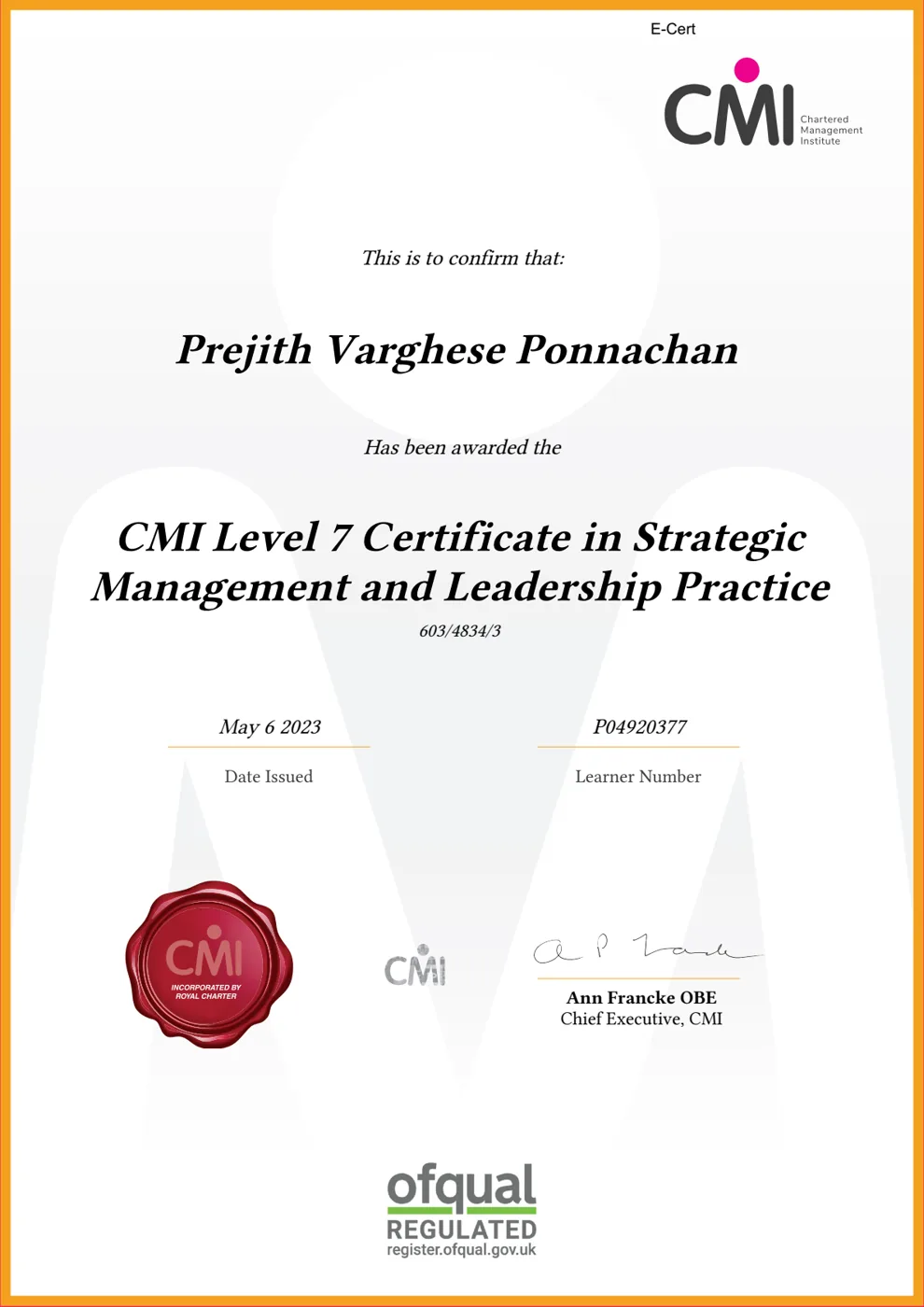
CMI Level 7, Strategic Management and Leadership PracticeChartered Management Institute
Six Sigma Yellow BeltCouncil for Six Sigma Certification
LanguagesEnglish · Malayalam · Hindi

Contact

Two ways to work together.

Hiring

Roles

Open to demand planning, supply chain analyst and inventory roles internationally.

  • Available within a month
  • Open to relocation anywhere
  • GCC and UK experience
Talk about a role

Advisory

Projects

Available to trading and distribution businesses for focused pieces of work.

  • Stock and working-capital reviews
  • Demand planning setup
  • Reporting and close automation
Discuss a project
Email
prejith.ponnachan1@outlook.com
LinkedIn
linkedin.com/in/prejith-ponnachan
Based in
Muscat, Oman

Figures on this page are shown as ratios and outcomes rather than absolute values, to keep employer data confidential. The diagrams and the cover monitor are drawn from scratch using invented data. Full detail is available on request.